

The valve itself, have a simple circuit enviable any transistor amplifier, however, not many projects that employ a single active component. This construction philosophy, I like to call it minimalism.
If one speaks of minimalism, I think, that this project has all the credentials to qualify as such.
This is an amplifier cu, a final integrated (Compact) which employs a single tube (triode) signed 6C45Pi. To do this, could be used several tubes, including 437A, E55L (pentode) and the fantastic and expensive EC8020.
Two lines must for this valve: The EC8020 has an exceptional linearity, high dissipation and trasconduttanza worthy of a power triode. All factors ideal for a good amplifier cu, were it not for the prohibitive price (on the ebay Offers easily exceed one thousand dollars!).
6C45Pi even if does not reach the performance of EC8020, performs the task with dignity. The cost is a couple of orders of magnitude lower and is currently produced by Electro Harmonix and is part of his series most valuable the Gold Pins.
Schematic DiagramThe circuit used setup is classic: single-ended. This choice leads to a lower power, an output transformer more expensive, but all will benefit, at least for my taste, the sound quality.
About nutrition, the first idea was to use, such as straightening, a valve, but with an excessive size of the Schottky diode and filtering capabilities have also obtained excellent results (Sonic).
PCBNot many projects are implemented on printed circuit valve, but it is my strong belief that, 's addition to a more orderly construction, provides added value to the success of the project.
The layout is as follows:
A fundamental rule in the design of the board is to avoid any link mass, so you should use as much as possible in a star structure. Usually the star center coincides with the negative of the first capacitor filter.
RealizationThe board:
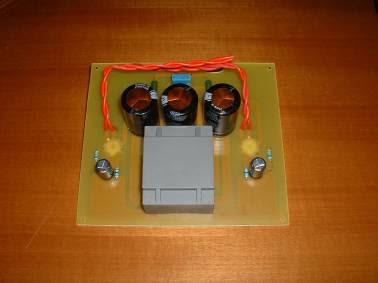
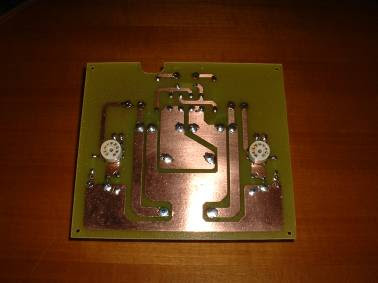
I used the usual method of iron more HCl + H 2 O 2.
Four resistors are metal film for half a watt, those from 220ohm wire wound vitreous enamel coated 6W, the Panasonic FC Electrolytic low impedance. Alps potentiometer, then the diodes, as already mentioned, type Schottky 1000V 1.5 A.
The two TU are wrapped by the Company upon specific ATC Electronix: www.atcelectronix.com/ provides the following features:
Primary: 4000 ohms
Secondary: 6 ohms
Power: 10W
Grain-oriented core AC 0:35
Bandwidth: 15 Hz - 75 KHz

I like to use for my projects output transformers wound on specific, because I have the opportunity to obtain more than I seek., The kind Mr. E. Calabrese's ATC Electronix has been immediately available, we discussed the characteristics and came quietly meeting.
Mechanically, the TU are well made, sturdy, beautiful black ice caps, we see that there is the hand of a fan.
Some photos of finished:
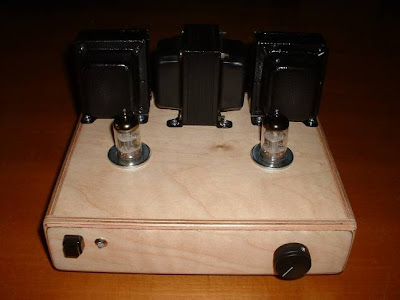
The cabinet is birch plywood 10mm polished with wax. I like the effect that old yellow comes out. The photos do not make the idea of greatness, but it is really small, only 230 x 200 mm high 60mm (TU and TA excluded).
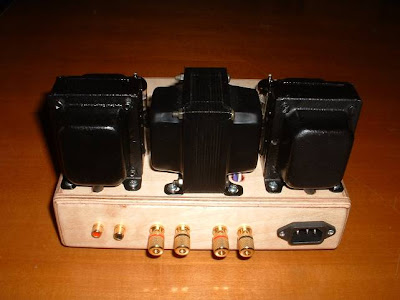
I suggest to the speaker terminals, derived from a larval bi-wiring connections, it was a very economical way to get the four terminals, buying in bulk would have cost me more.
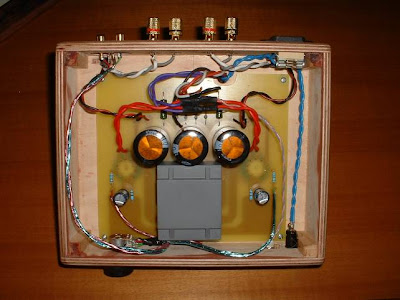
The cable used for connections between RCA, potentiometer and card is excellent Belden.
ListeningA valve, one triode and yet it sounds. Thought of having to keep the volume potentiometer can to listen to a decent level, but it was not at all. The pot did not exceed half of the race than I shouted down ... but we are talking about a "paltry" Watts!. Certainly the BLH (FE108ESigma) have done their bit (90 dB / W efficiency).
I connected everything, turned on and my room was immediately filled with music. Main features: detail, depth and dynamics.
Everything I heard sounded really good, thanks not only 6C45Pi but also of TU ATC Electronix.
The Finaly I am deeply moved, usually happens at concerts and my master amplifier.
The Medes and the voices are spectacular. I listened to all possible kinds of vocal music. Each of them seem natural, male or female is.
From Jazz to Classical, dall'Acustica the Rock and anything there is in the middle, everything comes back perfect. This little amp is very transparent.
Having experienced the one-tube amplifier, I had the confirmation: I will be forever minimal! Few watts, or only a few components in the audio chain, single screw speakers, no cross-over, no feedback, just pure music!. An amp like this, a simple player, a pair of single screw is all that a person has (or should have) need. I am extremely satisfied, so much so that I could separate me from my SE with the 2A3 and not feel greatly missed.
Faults? Sure. The sensitivity is very high, indeed it is low for maximum power output must be driven by almost 5 Vpp. The dynamic is good, but only one watt is just for musicians. However, the little man is promoted with flying colors while remaining down to earth.
(Source: http://digilander.libero.it/giovannidefilippo/progetti/GDF-UNICO!/UNICO.htm)


 shematic-Single-Ended-Class-A-Power-Amplifier-using-6C45Pi
 PCB-Layout-Single-Ended-Class-A-Power-Amplifier-using-6C45Pi